
If you own a business, a will is more important, not less. Your business interest is often your most valuable, and most complicated, asset.
The catch is that some of what you own may not pass under your will at all. Here is how a business changes your estate planning, and what a will needs to deal with.
1. Why a business makes a will essential
A will sets out who receives your assets when you die, and who administers your estate. Without one you die intestate, and your assets are distributed under a fixed statutory formula that may not reflect what you or your family need.
For a business owner, intestacy is especially blunt. Your interest in the business could pass to people who cannot or do not want to run it, be split in ways that make decisions impossible, or force a sale at the worst possible time.
A will lets you choose who inherits the business, whether they should keep or sell it, and who has the authority to act while your estate is being sorted out.
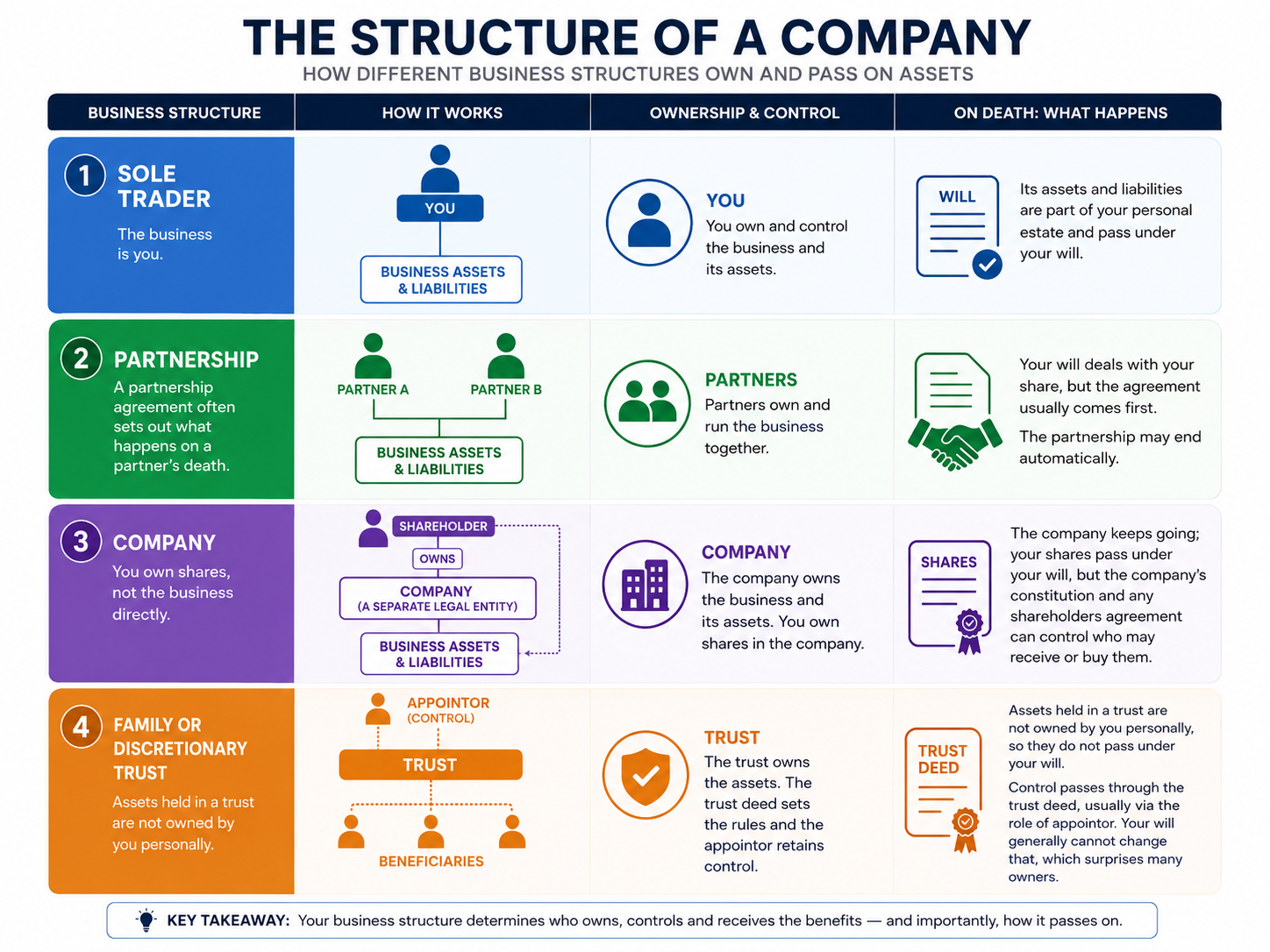
2. Your structure decides what your will can do
The single most important question is how the business is owned, because that decides whether your will controls it at all.
- Sole trader. The business is you. Its assets and liabilities are part of your personal estate and pass under your will.
- Partnership. A partnership agreement often sets out what happens on a partner's death, and the partnership may end automatically. Your will deals with your share, but the agreement usually comes first.
- Company. You own shares, not the business directly. The company keeps going; your shares pass under your will, but the company's constitution and any shareholders agreement can control who may receive or buy them.
- Family or discretionary trust. Assets held in a trust are not owned by you personally, so they do not pass under your will. Control passes through the trust deed, usually via the role of appointor. Your will generally cannot change that, which surprises many owners.
Two more things often sit outside your will. A buy-sell agreement between co-owners, often funded by insurance, can decide what happens to your interest on death, and it overrides your will. Superannuation, and any life insurance held inside it, is not automatically part of your estate either: it is paid according to the fund's rules and any binding death benefit nomination. Business owners often hold significant wealth there.
What your will controls depends entirely on how your business is owned.
3. What a business owner's plan should cover
A will for a business owner works well as part of a coordinated plan. The points worth getting right:
- who inherits your business interest, and whether they should run it or sell it
- alignment between your will and your shareholders agreement, partnership agreement, company constitution or trust deed, so they do not contradict each other
- succession of control of any trust, including who becomes appointor and trustee
- liquidity, so your estate is not forced to sell the business to pay debts, tax or other beneficiaries
- whether a testamentary trust in your will would help, for asset protection or flexibility for your beneficiaries
- an enduring power of attorney, so someone can run the business if you lose capacity, not only when you die
When to get advice
The time to plan is while you are well and the business is stable, not in a crisis. We can review how your business is owned, see what your will can and cannot reach, and make sure your estate plan and your business agreements work together. See our private advisory and estate planning page for how we help.

This article is general information only and is not legal advice. It may not apply to your circumstances, and the law can change. Seek advice tailored to your situation before acting.